
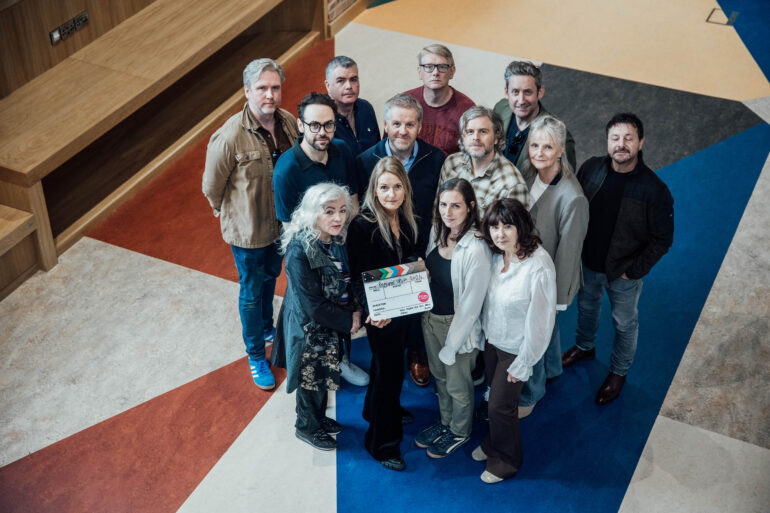
Film and television companies and industry representatives across Limerick and the Mid-West are calling on Government to introduce a renewed regional production incentive in Budget 2027. The campaign, supported by Screen Producers Ireland, Film in Limerick, Animation Ireland and Ardán, argues that Ireland needs a level playing field to build a truly nationwide screen sector, and that the industry cannot reach its full economic potential unless productions can compete on equal footing across the country.
The Mid-West has become one of Ireland’s most significant emerging production hubs, anchored by Troy Studios and backed by a rapidly expanding crew base and a growing network of production companies, suppliers, training providers and creative talent. The industry says the next step is to keep that momentum going and extend it nationwide, from Limerick and the Mid-West to the West, South and North-West.
The case for a regional uplift
The regional uplift attached to Section 481 was introduced in 2019 to encourage production outside Dublin and Wicklow. According to research published by Screen Ireland, it generated an average annual economic impact of 1,141 full-time equivalent jobs and €55.1 million in GVA between 2021 and 2023, before being phased down and ending in 2024.
A new Production Infrastructure and Capacity Analysis (PICA), commissioned from international screen-sector consultancy Olsberg SPI by Innovate Limerick/Film in Limerick, warns that the loss of the uplift has slowed screen production momentum in regional hubs, including the Mid-West. The report recommends a dedicated replacement incentive alongside a well-structured regional production fund.
Troy Studios provides a major purpose-built production facility in Limerick, and the region has developed its skills and crew ecosystem through partnerships with Local Authorities, Film in Limerick, Screen Ireland, Regional Skills Mid-West, Limerick and Clare Education and Training Board, and educational institutions. Recent productions including The Wayfinders, 4 Kids Walk into A Bank, Once Upon A Time In A Cinema, Bonhoeffer and Hidden Assets have filmed in Limerick, Clare and surrounding counties, with The Wayfinders based in Troy Studios and using locations across Clare and Tipperary.
What the industry is saying
Elaine Geraghty, Managing Director of Troy Studios, said the studio had shown what the region can do:
“Troy Studios has demonstrated the potential for Limerick and the Mid-West to play a significant role in Ireland’s film and television industry. A renewed regional incentive would help build on that progress and support greater production activity across the country. Ireland has the locations, talent and infrastructure to support film and tv production in every region and the opportunity now is to put the right framework in place to realise that potential.”
Stephen Hall, producer at Limerick-based Dark Day Pictures and producer of The Wayfinders, spoke from direct experience of bringing an international production to the city:
“We have seen first-hand what is possible when an international production comes to Limerick. But one successful production is not enough to build a sustainable industry. Crews need continuity of employment; companies need a pipeline of work and studios need productions coming through their doors year after year. The regional uplift is not about giving the regions an advantage over Dublin. It is about removing a structural disadvantage. A level playing field would allow Limerick and other regions to compete for the same productions and develop the capacity to grow.”
Anthony Muldoon, Director of Strategic Policy at Screen Producers Ireland, set out the wider economic argument:
“Ireland has built an internationally recognised screen industry, but the next phase of growth needs to be nationwide. A regional uplift gives producers the incentive they need to build production around regional studios and crews, while creating economic activity in accommodation, transport, construction, hospitality, catering and local businesses. If Ireland is serious about growing the value of its screen sector, we need a level playing field for productions considering locations outside Dublin and Wicklow. This will not only help reduce the pressure around Dublin, but bring more activity around the country.”
Paul C. Ryan, Regional Film Manager at Film in Limerick, said the policy framework now needs to catch up with the region’s investment:
“The Mid-West has worked to build the infrastructure, develop the crew base, support new production companies and demonstrate that major international productions can be delivered here. What we need now is the policy framework to allow that investment to reach its full potential and become sustainable.
“Without a functioning and long-term regional uplift, the regions cannot compete on a level playing field with Dublin and Wicklow. Ireland now has an opportunity to move from having a successful Dublin/Wicklow-centered screen industry to having a genuinely nationwide one. Budget 2027 is the moment to make that happen.
“The question now is whether Ireland wants to grow its screen industry incrementally around an existing centre, or whether it wants to build a genuinely national one. Limerick and the Mid-West have the studio, the locations, the talent and an increasingly experienced crew base, and other regions have their own capabilities. With the right policy support, Ireland could have a network of production hubs that collectively doubles the economic value of the sector over time. The opportunity is there. Budget 2027 should be the point at which Government backs that ambition.”